
Tracking Progress in Emergent Initiatives: Why Adaptive Progress Markers Matter
Written by Jess Dart
Systems change rarely follows a straight path. It’s complex and emergent, often feeling like navigating the unknown, especially when stakeholders ask, “Are we on track?”
What we’ve learnt is that traditional targets fall short here. They assume predictability and linear progress, yet this doesn’t reflect the reality of emergent or long-term, multi-partner initiatives, such as place-based approaches and systems transformation.
When you’re doing long-term systems change work, it can be tempting to skip targets altogether. Targets take time to develop, and then, lo and behold, you learn more about the system and adapt your work, and the long-term target may not even be on the page! Or something else may come into focus that is important. However, we would suggest you don’t turn your back on targets altogether. There may be a way to find some shorter-term, more adaptive markers of success that can provide focus, transparency and accountability.
That’s where adaptive progress markers come in. They can be qualitative or quantitative and offer a practical way to spot early shifts, centre learning, and maintain accountability that supports adaptation. Unlike rigid long-term targets, adaptive progress markers focus on shorter cycles (e.g., 6 months). We ground them in our sphere of influence and evolve them as the context changes. They are designed to track signs of systemic change, such as shifts in power, resource flows, or narratives, long before population-level outcomes emerge.
Clear Horizon developed this approach by adapting Outcomes Mapping and refining it over a decade of practice.
Our approach is underpinned by a theory of progress – a hypothesis about how change will unfold over time, especially in the early stages. It could look like a steady climb (the mountain), a slow start followed by acceleration (the hockey stick), layered foundations leading to breakthroughs (the tiramisu), a surge forward followed by a reversal before moving forward again (the zigzag), or a spread from one progress area (the petri dish). Discussing and making your theory of progress explicit helps manage expectations and design markers that reflect the messy, non-linear nature of systems change.
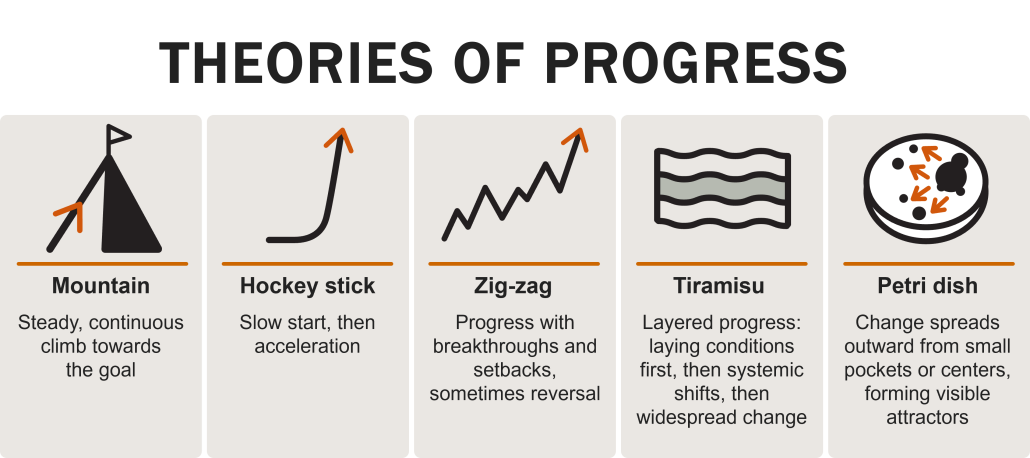
Take VicHealth as an example (image below). Working with Clear Horizon, VicHealth developed an Impact and Evaluation Framework for their 10-year strategy to create a healthier, fairer Victoria. In reflection, VicHealth’s theory of progress combined the tiramisu and petri dish archetypes: first laying the foundations and then seeing change spread in pockets. Adaptive progress markers will help VicHealth track early system shifts, such as new collaborations and policy changes, and provide confidence that the strategy is moving in the right direction.
Underpinning the shared use of adaptive progress markers is also a shift in how we approach accountability. In complex change, accountability moves away from “delivering pre-set results” and focuses on stewarding learning and adaptation. Adaptive progress markers support this shift. They make the invisible visible, enabling evaluators, change-makers and collaborators to tell an evidence-informed story of progress – even in the messy middle of systems transformation.
Read the full paper to explore the methodology, guardrails, and practical steps for implementing adaptive progress markers in your work.